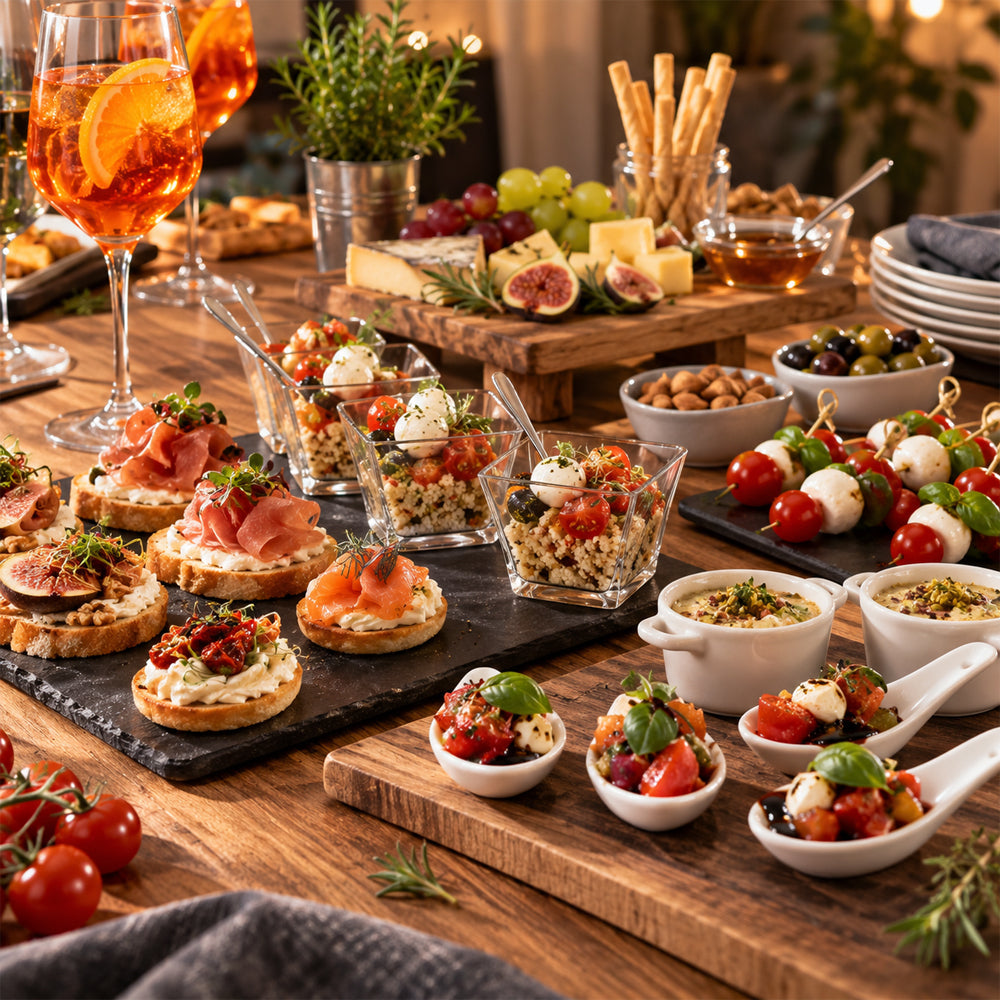
Quick Finger Food for a Home Aperitif: Simple Ideas to Serve Beautifully
Hosting a home aperitif does not necessarily mean spending hours in the kitchen. Simple preparations, well-chosen ingredients and a presentation that makes even the most essential menu look neat and inviting often work best.
Finger food is perfect for exactly this reason. It is served in small portions, lets guests sample different dishes and turns the table into a sociable, informal space.
However, it is not just about what you prepare. How you serve the snacks matters too: serving boards, small cups, trays, tasting spoons and little containers help keep dishes separate, manage portions more easily and create a more polished overall look.
In this guide, we look at what to make for a home aperitif, which finger foods to choose, how to organise an apericena and which accessories can make serving more practical.
A successful aperitif does not need twenty recipes. A few different bites, served neatly and easy to pick up while chatting, are all it takes.

Finger food: what does it really mean?
Finger food refers to dishes designed to be eaten easily in one or a few bites, often without using conventional table cutlery.
It does not identify a specific recipe, but rather a way of portioning and presenting food.
A vegetable cream soup can become finger food when served in a small cup. The same applies to couscous, grain salads, meatballs, mini eggplant parmigiana, frittatas, canapés or single-serving desserts.
It is this flexibility that makes finger food especially well suited to home aperitifs, buffets and apericene: it allows you to combine cold and hot dishes without creating an overly rigid menu.
What should you make for a home aperitif?
The most common mistake is thinking an aperitif needs a huge number of dishes. In fact, four or five different options are often enough to create variety, as long as they alternate textures and flavours.
You can build your menu by combining:
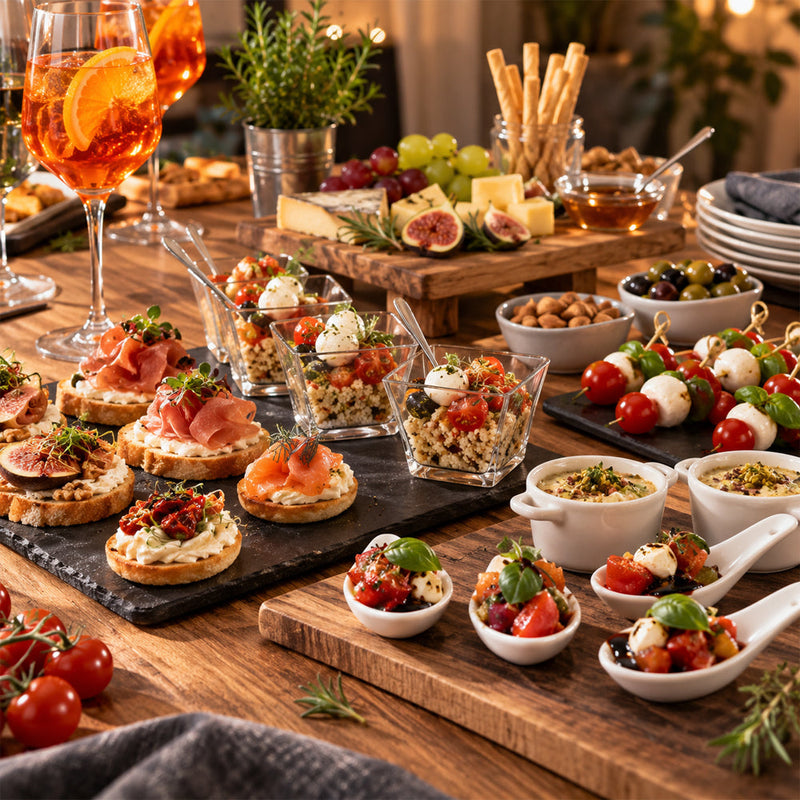
- canapés and crostini with cheese, vegetables, cured meats, hummus or fish;
- mini skewers of mozzarella and tomato, cheese and fruit, or vegetables;
- meatballs and mini frittatas that are easy to make ahead;
- olives, nuts and cheese served on boards and snack trays;
- couscous, pasta salad and grain salads in small individual portions;
- mini desserts to end the aperitif with something sweet.
The aim is not to create an endless buffet. It is to offer different choices while keeping service easy for the host, too.
Quick aperitif canapés: a classic that always works
Aperitif canapés remain one of the most versatile options because they can be assembled in minutes and easily adapted to the season.
Toasted bread, focaccia, crackers or small crostini can become the base for many different combinations.
Canapés with burrata and cherry tomatoes
A crisp base, burrata and cherry tomatoes dressed just before serving. Finish with basil or a few drops of extra-virgin olive oil.
Crostini with hummus and vegetables
Hummus is also an excellent way to make a plant-based option. Pair it with grilled vegetables, cherry tomatoes, crispy chickpeas or aromatic herbs.
Canapés with salmon and fresh cheese
A simple combination that works particularly well for cold aperitifs. Prepare them shortly before guests arrive to keep the base crisp.
Crostini with prosciutto crudo and figs
When they are in season, figs create a sweet-and-savoury contrast with very few ingredients.
The same rule applies in all these cases: a few recognisable, well-balanced ingredients are often more effective than overly elaborate preparations.
Serving boards and snack trays: how to serve cured meats, cheese and nibbles
Not everything needs to be served individually. Some foods work better when shared in the centre of the table.
Serving boards, trays and snack holders are especially useful for cured meats, cheese, olives, taralli crackers, nuts, bread, focaccia and small nibbles.
Arrange the presentation in groups: one area for cheese, one for cold cuts and one for accompaniments. This makes it easy for guests to help themselves and keeps the table more orderly.

Cheese, cured meats, olives and snacks do not need complicated preparation: a well-organised serving board immediately turns them into a centrepiece of the aperitif.
Single-serving finger food: when presentation changes everything
The same dish can take on a completely different appearance when served in a small individual portion.
A vegetable cream soup in a small cup, a mini lasagna in a small casserole dish or couscous served in an individual container look neater and let guests try more dishes without overfilling their plate.
Individual portions are also particularly useful for managing quantities: every dish has a defined serving size and the table stays tidy throughout the evening.
In the Paderno Finger Food collection, you will find small cups, ramekins, mini casserole dishes, mini saucepans, tasting spoons and small serving pieces designed specifically for aperitifs, tastings and individual desserts.
Cold finger-food ideas to prepare ahead
Making some recipes in advance means you will not spend the evening in the kitchen once your guests have arrived.
Among the easiest cold finger foods, you can make:
- couscous with vegetables;
- spelt or barley salad;
- mini caprese salads;
- mozzarella and cherry tomato skewers;
- hummus with raw vegetables;
- savoury mousses served in small cups;
- cheese with honey, preserves or fruit.
You can keep them in the refrigerator and finish the presentation shortly before serving, adding any crunchy elements only at the last minute.
Hot finger food: simple ideas to serve
Not everything has to be served cold. Adding one or two hot options makes the aperitif more complete, especially in autumn and winter.
Some of the easiest ideas include:
- mini frittatas;
- meat or vegetable meatballs;
- small portions of eggplant parmigiana;
- mini quiches and savoury tarts;
- croquettes;
- au gratin vegetables;
- mini portions of baked pasta.
The advantage of individual portions is that they can be brought straight to the table while keeping the presentation more orderly.
How to organise an apericena at home
When the aperitif is meant to replace dinner, the menu needs to be slightly more substantial.
A good home apericena can be built around three levels:
- snacks and opening bites: olives, taralli crackers, nuts, cheese and cured meats;
- finger food: canapés, skewers, meatballs and individual portions;
- more substantial dishes: couscous, pasta salad, savoury tarts, mini lasagnas or grain salads.
There is no need to prepare a huge quantity of each recipe. It is much more appealing to offer several options in smaller portions, allowing guests to put together their own selection.
How to arrange a buffet for an aperitif
Organising the table well can make serving much simpler, too.
You can mentally divide the buffet into areas: plates and napkins at the start, savoury dishes in the centre, sauces and accompaniments close to the foods they are intended for, and drinks in a separate area.
Keeping the cocktail station separate from the food also prevents too many people from gathering in the same spot at once.
For shared dishes, serving boards, snack holders and trays make it possible to create small visual groupings and keep the table less cluttered.
What about drinks? Cocktails and aperitifs should be planned together
An aperitif is not complete without a drinks offering. There is no need to create a bar-style cocktail menu: two or three options are more than enough.
You could offer, for example:
- Spritz;
- Gin and Tonic;
- Americano;
- a non-alcoholic cocktail;
- wine or sparkling wine for those who prefer something simpler.
To make cocktails at home more precisely, tools such as a shaker, jigger, mixing glass, bar spoon, strainers and ice buckets are especially useful.

A shaker, jigger and mixing glass are not there to make an aperitif more complicated: they help you measure ingredients more accurately and make more consistent cocktails at home.
In the bartending equipment collection, you can find useful tools for setting up a small cocktail corner, even in a home kitchen.
Wine and bar-serving accessories: details that make the evening easier
If you are serving wine, sparkling wine or other beverages in addition to cocktails, it is worth planning the service as well.
Bottle openers, corkscrews, ice buckets, wine accessories and barware save you from constantly searching for utensils during the evening.
The wine and bar-serving accessories collection helps complete the drinks area and keep it separate from the buffet.
If you are serving cocktails, wine and sparkling wine, create a small drinks area separate from the buffet: less clutter on the table and more freedom for guests.
How much finger food should you prepare per person?
The quantity depends mainly on the role the aperitif will play.
If it comes before a proper dinner, a few bites per person are enough. If you are organising an apericena that replaces the meal, it makes sense to increase both the variety and quantity, adding more substantial dishes as well.
A practical guideline is to avoid giving every option the same weight: alternate small snacks, light bites and two or three more complete dishes.
This way, the buffet feels abundant without requiring large quantities of every single recipe.
What can you prepare the day before?
Many dishes can be made ahead, considerably reducing the work just before guests arrive.
The day before, you can prepare dips, hummus, some savoury tarts, meatballs, couscous and grain bases, desserts and a variety of dressings.
It is best, however, to assemble anything that needs to stay crisp, such as crostini and canapés, at the last minute, or to add shortly before serving any ingredients that may release water.
Mistakes to avoid when hosting a home aperitif
- Making too many recipes: it increases the workload without necessarily improving the experience.
- Serving everything in the same way: alternating boards, trays and individual portions makes the buffet easier to navigate.
- Preparing everything at the last minute: choose recipes that can at least partly be made ahead.
- Forgetting alternatives: including at least one vegetarian option makes the menu more versatile.
- Overcrowding the table: leave room for glasses, small plates and for guests to move around.
- Keeping food and cocktails in the same spot: separating the two areas makes serving easier.
Frequently asked questions about finger food for an aperitif
What should you make for a quick home aperitif?
You can combine canapés, cured meats and cheese, olives, nuts, mini skewers and one or two individual portions. There is no need to make many recipes: variety and presentation matter more than quantity.
Which finger foods can be prepared ahead?
Couscous, grain salads, meatballs, frittatas, hummus and some savoury tarts can be made in advance. It is best to finish canapés and crisp dishes shortly before serving.
What should you serve for an apericena?
For an apericena, you can serve more substantial dishes alongside snacks, such as pasta salad, couscous, savoury tarts, meatballs, mini lasagnas and grain salads.
How should you present finger food?
You can use small cups, mini casserole dishes, tasting spoons, small trays and ramekins. Individual portions help keep dishes separate and make serving simpler.
What should you put on an aperitif board?
A serving board can include cheese, cured meats, olives, nuts, crackers, bread, focaccia, honey, preserves or fresh fruit. It is useful to arrange the ingredients in small groups, leaving space between each preparation.
Which cocktails should you make for a home aperitif?
Spritz, Gin and Tonic, and Americano are among the easiest options. It is also helpful to include a non-alcoholic option and have wine or sparkling wine available for those who prefer simpler drinks.